 Contact Us
 Appointment

Book An Appointment
Get in touch with our jewellery experts for virtual consultation
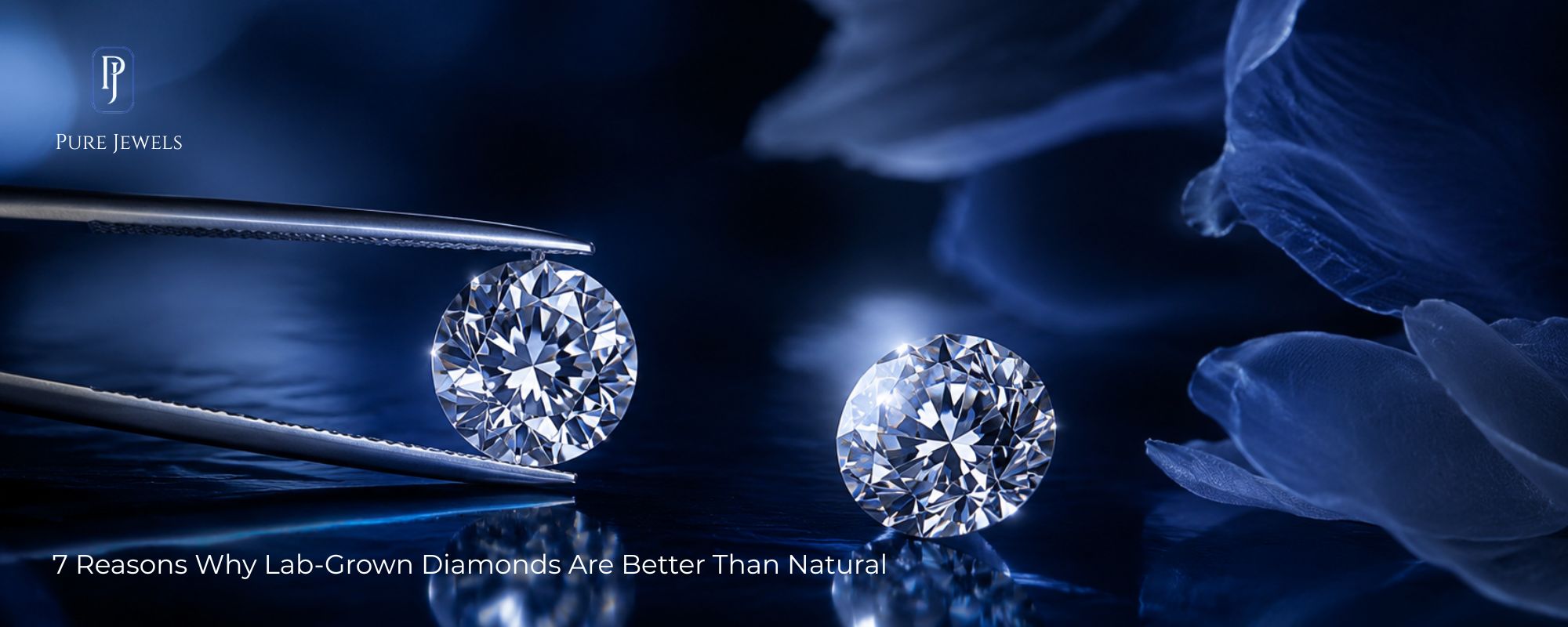
7 Reasons Why Lab-Grown Diamonds Are Better Than Natural


.webp)
.webp)
.webp)
.webp)


 Share on Facebook
 Share on LinkedIn
 Share on WhatsApp
If you're shopping for diamonds in India right now, you've probably noticed the conversation has shifted. A few years ago, "lab-grown" sounded like a compromise. Today, it's the choice savvy buyers are actively seeking out and for reasons that go well beyond price.
We've put together seven honest, fact-checked reasons why lab-grown diamonds in India are winning over buyers, along with the real numbers behind each claim.
1. Real Savings, Backed by Real Numbers
Lab-grown diamonds typically cost 30–40% less than mined diamonds of the same carat, cut, and clarity, because they skip the decades-long mining, sorting, and global distribution chain that drives up natural diamond prices.
Here's what that looks like in practice: a 1-carat solitaire that costs around ₹5 lakhs in a natural diamond can cost ₹3 lakhs or less as a lab-grown equivalent with zero compromise on the 4Cs. That difference is often enough to move up a full carat weight or clarity grade within the same budget.
Browse our solitaire collection to compare carat-for-carat pricing yourself.
2. Conflict-Free by Design, Not by Marketing
Natural diamond mining has a documented history of environmental disruption and, in some regions, conflict financing issues that led to international frameworks like the Kimberley Process, which still has well-known gaps in tracking diamond origin end-to-end.
Lab-grown diamonds remove this question entirely. Every stone is grown in a monitored facility using CVD (Chemical Vapour Deposition) or HPHT (High Pressure High Temperature) technology. There's no excavation, no displaced communities, and no ambiguity about where the stone came from.

3. The Environmental Math, With Actual Figures
This is where lab-grown diamonds make their strongest case and it's not vague. Industry research comparing the two production methods shows:
Water use: Mined diamonds consume upwards of 126 gallons of water per carat versus roughly 20 gallons for lab-grown stones.
Land disruption: Diamond mining displaces close to 100 square feet of earth and generates thousands of pounds of mineral waste per carat extracted.
Carbon output: Mined diamonds generate over 125 lbs of carbon per carat; lab-grown diamonds produce under 10 lbs.
Energy use: Mining and processing a mined diamond uses roughly 500 million joules of energy per carat. Lab-grown production uses about half that.
A lab-grown diamond also takes weeks to grow, rather than the geological timescales (and extensive logistics) behind a mined stone reaching a showroom.
4. Same Carbon, Same Hardness, Same Forever
A lab-grown diamond is chemically, physically, and optically identical to a mined one; both are pure crystallised carbon rated 10 on the Mohs scale, the hardest natural material known. That means the same scratch resistance, the same fire and brilliance, and the same lifespan: forever, with normal care.
Even trained gemologists need specialised equipment, not a standard jeweller's loupe to identify a stone's origin. The growing technology has also matured enough that lab-grown diamonds beyond 10 carats are now realistically achievable, a size range
that was nearly unthinkable in lab settings just a decade ago.
5. Certification You Can Actually Verify
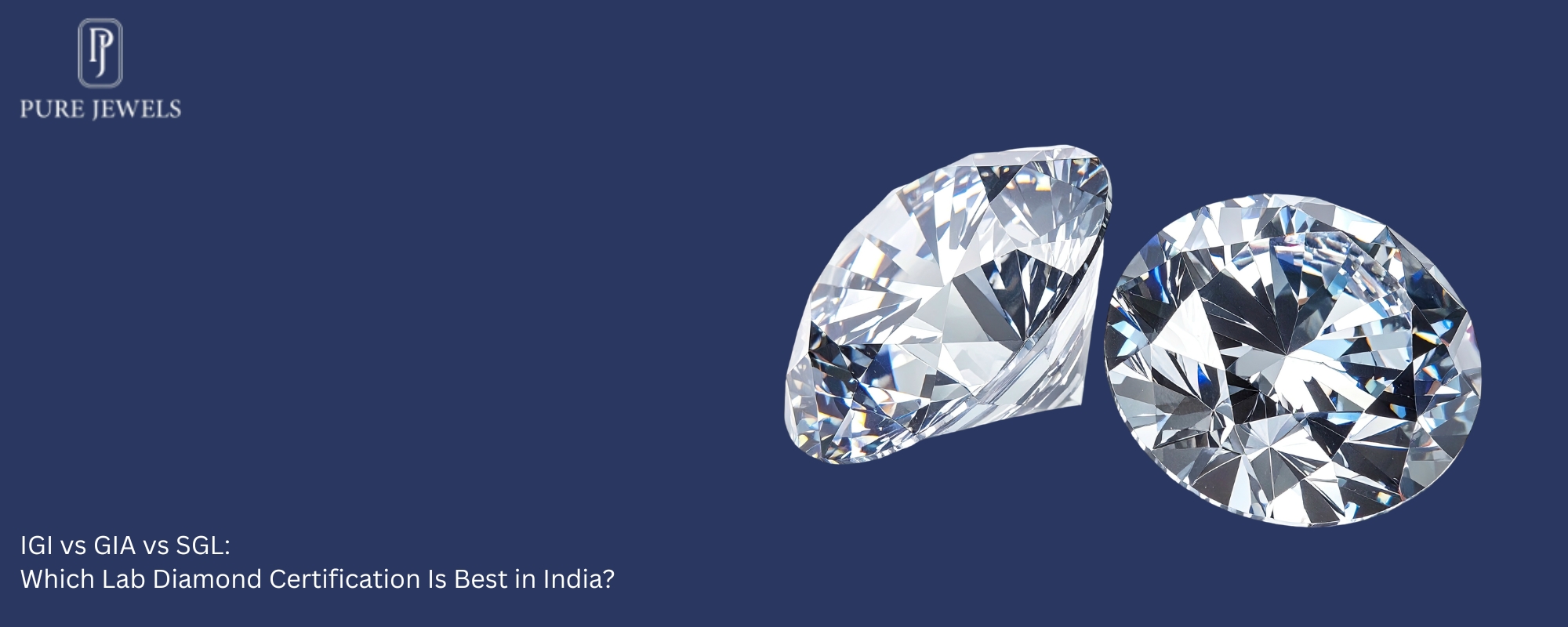
At Pure Jewels, every lab-grown diamond ships with IGI or SGL certification, documenting carat weight, cut, colour, and clarity exactly as it would for a natural stone.
It's worth knowing the difference between two terms that buyers often confuse:
A grading certificate identifies the stone and its 4Cs.
An appraisal estimates the stone's replacement value for insurance purposes, based on current market pricing.
If you're insuring a piece, ask for both; most jewellers, including us, can guide you through getting an appraisal alongside your certificate.
6. More Creative Freedom, Fewer Compromises
Because lab-grown diamonds aren't limited by what nature happens to produce, sourcing specific colours, sizes, and shapes is far more consistent and affordable. This matters most when you're designing something personal, a custom engagement ring, a matched pair of studs, or a diamond bracelet built around a particular vision rather than whatever stock happens to be available.

7. An Honest Take on Resale Value
Let's be direct about this one: lab-grown diamonds currently resell for less than natural diamonds, and we won't pretend otherwise. But here's the context that's usually left out: no diamond, lab-grown or natural, is a reliable financial investment unless you're dealing in rare, museum-grade stones through specialist auction houses. Both types lose significant resale value the moment they leave the store, simply because of how the resale market works.
If you're buying a diamond to wear and love rather than to trade, the lower upfront cost of a lab-grown stone usually outweighs any difference in resale value and that gap is narrowing every year as market acceptance grows.
The Bottom Line
Lab-grown diamonds give you everything a natural diamond offers: the brilliance, the hardness, the certification, the emotional weight of the moment, without the ethical question marks, the environmental cost, or the inflated price tag.
At Pure Jewels, every lab-grown diamond comes IGI/SGL certified, ethically produced, and backed by our 100% exchange guarantee and 15-day return policy. Whether you're shopping for an engagement ring, a pendant, or a custom piece, explore our collections and see why more Indian buyers are choosing lab-grown not as a compromise, but as the smarter choice.

Frequently Asked Questions
Are lab-grown diamonds as hard as natural diamonds?
Yes. Both score 10 on the Mohs scale and offer identical durability.
Can jewellers tell the difference between lab-grown and natural diamonds?
Not with the naked eye or a standard loupe. Specialised lab equipment is needed to identify the growth method.
How long do lab-grown diamonds last?
Indefinitely, their physical structure doesn't degrade differently from a mined diamond's.
Is buying a lab-grown diamond a good investment?
Diamonds, in general, aren't reliable financial investments. Lab-grown diamonds are best valued for what they offer immediately: brilliance and savings, not appreciation.
What certifications do Pure Jewels diamonds carry?
All our lab-grown diamonds are certified by IGI or SGL based on the standard 4Cs grading framework.
Do lab-grown diamonds lose sparkle over time?
No, their optical properties remain unchanged for life, just like natural diamonds.
Why are lab-grown diamonds so much cheaper than natural ones?
They're grown in weeks rather than requiring large-scale mining and global supply chains, which removes most of the cost that natural diamonds carry before they even reach a showroom.

Contact Us
3rd Floor, Building E-2, F.P.108/P, Naginawadi Road, Opp. RJD Business HUB, Katargam, Surat - 395004.India


Limited Edition Gift with Purchase
A sparkling deal only while supplies last.
Spend ₹1,00,000 or more
and select one of these complimentary gifts
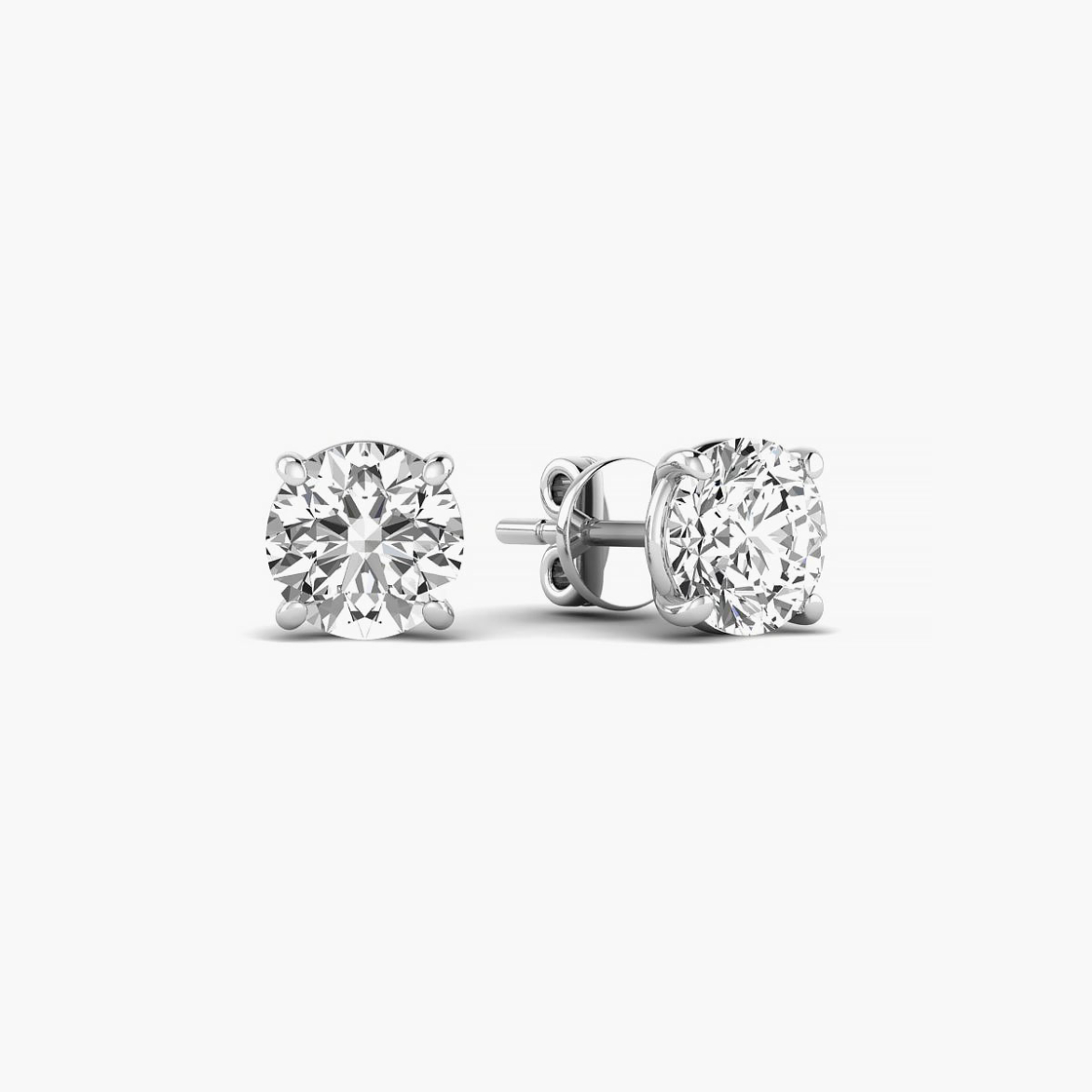
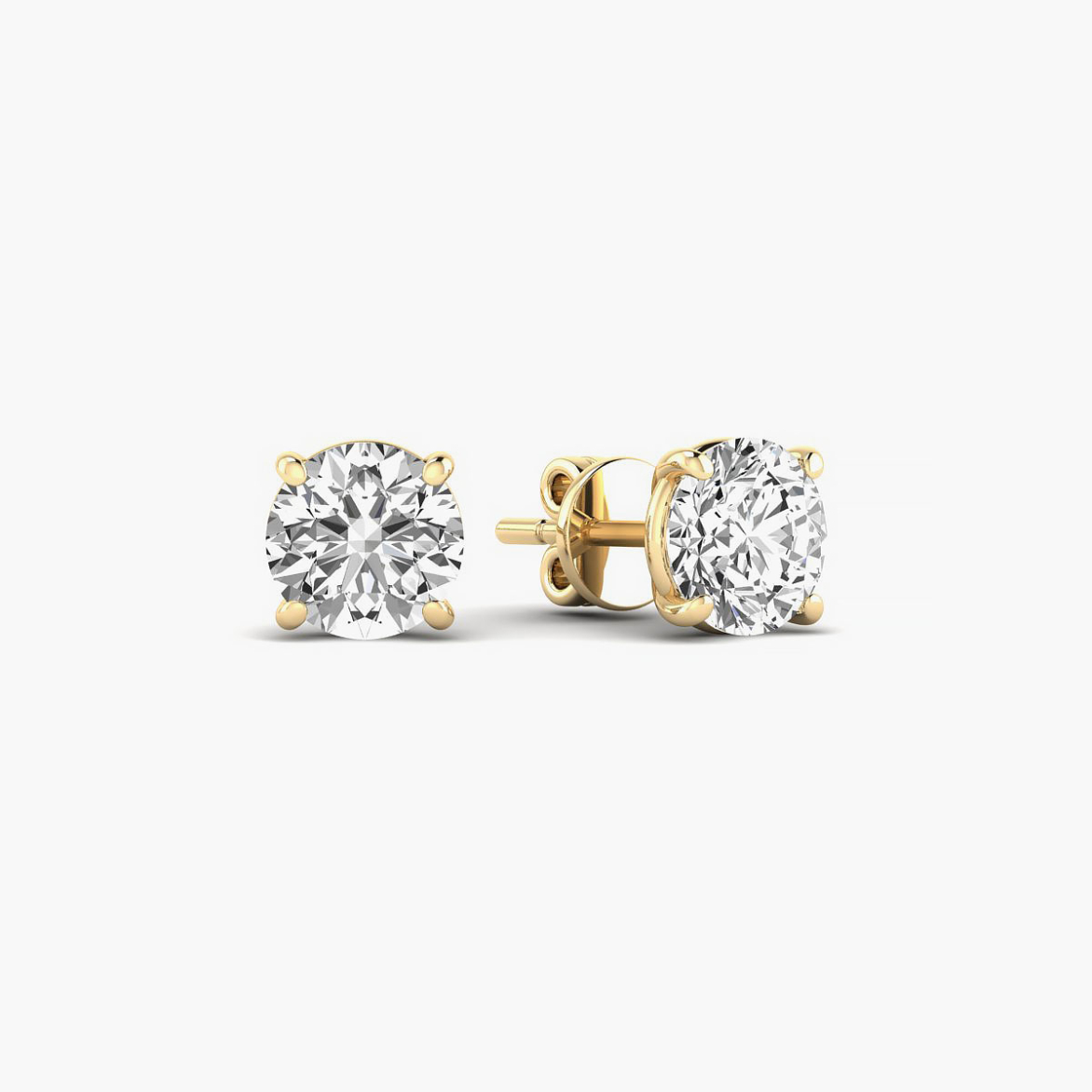
Lab Grown Diamond Stud Earring
14KT White Gold - Gift With Purchase