 Contact Us
 Appointment

Book An Appointment
Get in touch with our jewellery experts for virtual consultation
Gold Hallmarking & GST Rules on Lab-Grown Diamond Jewellery in India


.webp)

.webp)
.webp)
.webp)


 Share on Facebook
 Share on LinkedIn
 Share on WhatsApp
Lab-grown diamond jewellery in India is taxed at 3% GST on the finished piece under HSN 7113, with an additional 5% GST on making charges if billed separately, and the gold used in the setting must carry a BIS hallmark with a six-character HUID code in most districts.
Beyond the rate itself, how these charges are billed, whether the hallmark is genuine, and whether the diamond certificate actually matches the stone in front of you are what decide whether you are paying a fair price. The checklist below applies to any lab-grown diamond jewellery purchase in India, regardless of which jeweller you buy from - use it to question your invoice, verify your hallmark, and check your certificate before you sign.
Here are 9 things to check before you sign a bill:
Verification note: GST rates and hallmarking rules below are checked against current GST Council and BIS sources as of August 2026. Rates and coverage figures are subject to change - confirm current rates before filing or relying on them for a purchase decision. This article is for general information and is not tax advice.
Quick summary:
Gold hallmarking: Mandatory in 392+ notified districts across India for 14K, 18k to 24K gold jewellery, verified through the HUID code on the BIS Care app.
GST on diamond jewellery: 3% on the total invoice value (diamond + gold + making charges) if billed as one composite amount.
GST on making charges: 5% if the jeweller itemises making charges separately on the invoice, instead of folding them into the 3% composite rate.
Watch for: the same making charges being taxed twice, once inside a composite 3% and again as a separate 5% line.

1. Ask for an itemised bill first
Before discussing anything else, ask the jeweller to break the price into four separate parts: diamond value, gold value, making charges, and GST. A jeweller who itemises this without hesitation is one you can verify against.
One who insists on a single lump-sum figure makes it impossible to check whether the tax or the making charges are correct, and it becomes your word against theirs if a dispute comes up later.
2. Confirm which GST rate applies to which part
Lab-grown diamonds are taxed the same as natural diamonds once set into jewellery. There is currently no separate, reduced GST slab for finished lab-grown diamond pieces, despite industry bodies requesting one from the GST Council.
3. Watch for the double-taxation trap

This is the single most useful check on this list. Some invoices charge the composite 3% on the full bill value (diamond + gold + making charges combined), and then add a separate 5% GST on making charges again as its own line.
That is double taxation on the labour component, and it does happen. Either the full value is taxed once at 3% as a composite supply, or the making charges are pulled out and taxed separately at 5% on top of 3% on the diamond and gold alone.
Both methods are compliant on their own; charging both on the same making-charge amount is not, and it is worth pointing out to the jeweller directly if you spot it.
4. Understand how making charges are actually calculated
Making charges are billed one of two ways: as a percentage of the gold value, or as a flat rate per gram. A percentage-based charge rises every time gold rates rise, even though the labour has not changed.
A flat per-gram rate is usually more transparent and tends to work out better on heavier pieces. Ask which method your jeweller uses and ask for the specific figure rather than accepting a vague estimate.
Making charges are generally negotiable, particularly on higher-value purchases, and festive discounts are frequently applied to making charges alone rather than to the full bill, so read any "percentage off" offer carefully.
5. Ask about wastage charges separately
Wastage charges are a legacy practice from handmade jewellery, where a small amount of gold was genuinely lost during working. Modern manufacturing loses very little, but the charge still appears on some bills, sometimes as a percentage layered on top of making charges.
Ask directly whether wastage is being charged, at what rate, and whether it duplicates making charges already on the bill. Wastage charged on top of a full making charge with no explanation is worth pushing back on.
6. Verify the gold hallmark and its purity number

Every hallmarked gold piece carries a six-character HUID alongside the BIS logo and a purity number matching the karat. The purity numbers to check against are 916 for 22K gold, 750 for 18K gold, and 585 for 14K gold. Enter the HUID into the BIS Care app or bis.gov.in while you are still at the counter.
If the code returns no result, or if the purity number does not match the karat you were quoted, the hallmark does not confirm what you were told, regardless of how convincing the physical stamp looks.
Hallmarking has been compulsory since June 2021 for 14K to 24K gold, and as of August 2026, mandatory coverage extends to 392 districts across 26 states and union territories.
7. Verify the diamond certificate against the stone itself, not just the paperwork.
A printed summary card is not the same as a full grading report. Ask for the complete certificate from a recognised lab and look up the report number directly on the laboratory's own website.
Then go one step further: most certified stones carry a laser inscription on the girdle matching the certificate number, visible under magnification. Ask the jeweller to show you this inscription and confirm it matches the report you were given, along with the carat, colour, clarity, and cut.
As an industry convention rather than a statutory rule, individually certified grading is typically expected for stones above 0.20 carats; smaller accent stones in a cluster setting are often sold uncertified, but the centre or main stone should never be.
8. Ask about insurance documentation on higher-value pieces
For jewellery valued above roughly ₹2 lakh, ask whether the seller provides or facilitates an insurance certificate alongside the purchase invoice. This is separate from the buyback or exchange policy and covers loss, theft, or damage. Not every jeweller offers this by default, so it is worth asking rather than assuming it is included.
9. Do the invoice math yourself once

On a piece where the diamond and gold together are valued at ₹90,000 and making charges are billed separately at ₹10,000, the correct GST is 3% of ₹90,000 (₹2,700) plus 5% of ₹10,000 (₹500), for a total of ₹3,200. A composite invoice at a flat 3% on the full ₹1,00,000 comes to ₹3,000 instead. If your bill shows a number higher than either of these two totals for the same components, ask the jeweller to explain the difference before paying.
Red flags to walk away from
An invoice that will not break out diamond, gold, making charges, and GST separately
3% charged on the full bill and 5% charged again on the same making charges
A whose HUID does not resolve on the BIS Care app, or whose purity number does not match the karat quoted
A diamond certificate you are shown but not allowed to look up independently, or a girdle inscription that does not match the report number
Wastage charged on top of full making charges with no explanation given
No insurance documentation offered on a purchase well above ₹2 lakh, with no explanation of why
What Pure Jewels India offers on certification and hallmarking
Every piece at Pure Jewels India is certified by SGL Laboratory, gold is hallmarked, and diamond certification is available on request for our lab-grown diamond jewellery. Our lab-grown diamonds are also graded by IGI, with a laser inscription on the stone confirming its lab-grown origin. Use the checklist above to verify any of these, including on a Pure Jewels India purchase.
Frequently Asked Questions
Is BIS hallmarking mandatory for the gold in lab-grown diamond jewellery?
Yes, in all districts where gold hallmarking is mandatory. The hallmarking law applies to the gold setting regardless of whether the stone is natural or lab-grown.
What GST rate applies to a lab-grown diamond ring?
3% GST applies to the finished piece if billed as one composite value, or 3% on the diamond and gold plus 5% on making charges if the jeweller itemises them separately. Both should never be charged on the same making-charge amount.
What are wastage charges, and should I be paying them?
Wastage charges cover gold lost during handcrafting. Modern manufacturing loses very little, so ask specifically whether it is being charged, at what percentage, and whether it duplicates making charges already on the bill.
How can I verify a hallmark is genuine?
Enter the six-character HUID printed on the piece into the BIS Care app or bis.gov.in, and confirm the purity number (916, 750, or 585) matches the karat you were quoted.
How do I know a diamond certificate actually belongs to my stone?
Check the report number on the certificate against the laser inscription on the diamond's girdle, visible under magnification, and verify the report number independently on the issuing lab's website.
Is GST on lab-grown diamond jewellery lower than on natural diamond jewellery?
No. Both are taxed at the same 3% rate once set into finished jewellery, since GST is applied by HSN classification for jewellery, not by the diamond's origin.

Contact Us
3rd Floor, Building E-2, F.P.108/P, Naginawadi Road, Opp. RJD Business HUB, Katargam, Surat - 395004.India


Limited Edition Gift with Purchase
A sparkling deal only while supplies last.
Spend ₹1,00,000 or more
and select one of these complimentary gifts
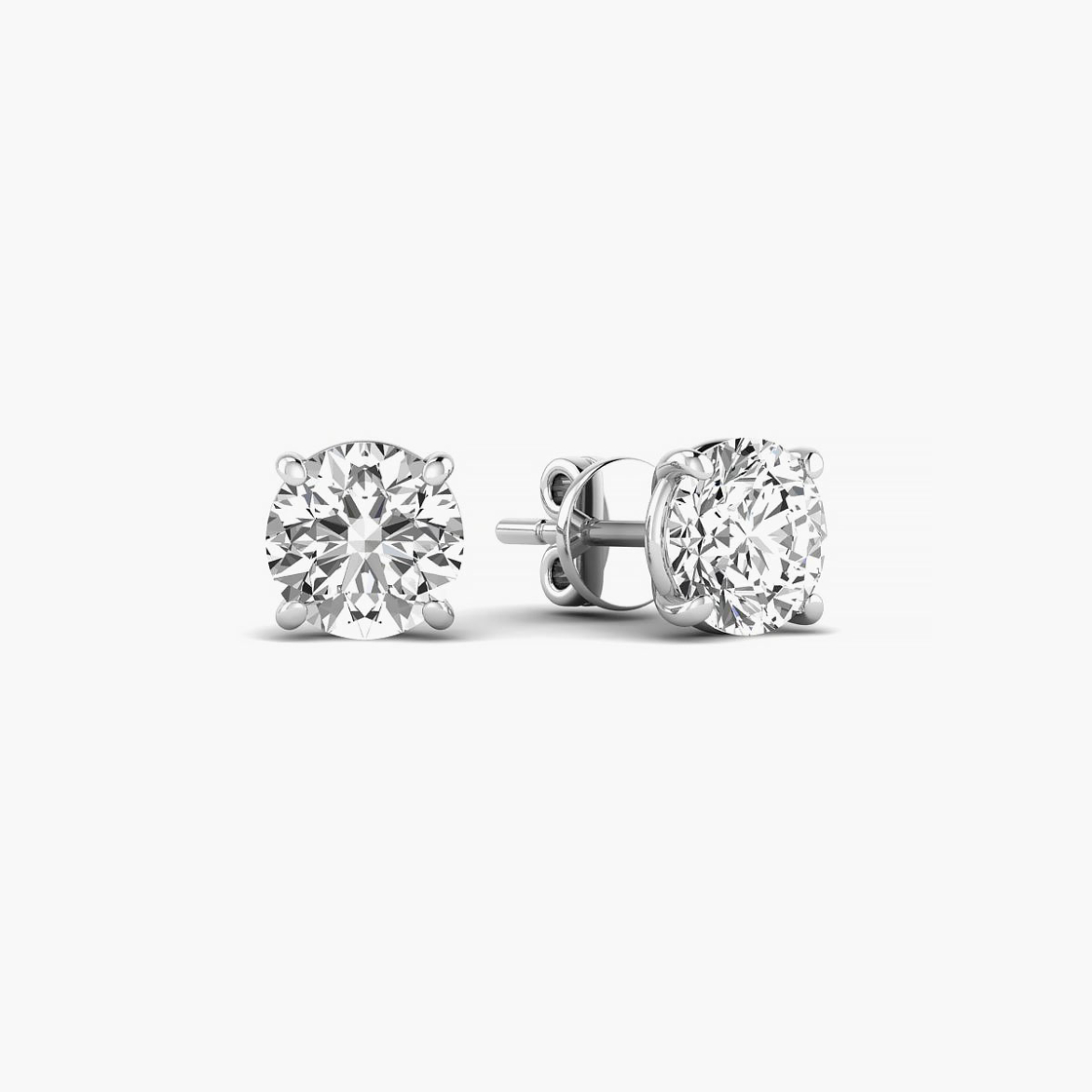
Lab Grown Diamond Stud Earring
14KT White Gold - Gift With Purchase